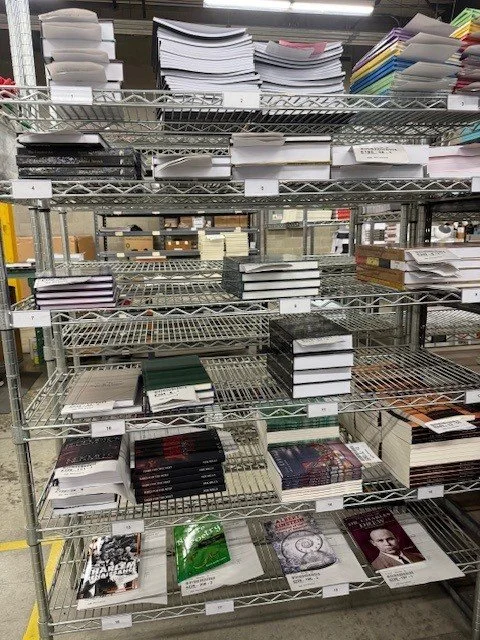
For a long time, the relationship between a publisher and printer was pretty straightforward. Send the files. Send the PO. Print the books.
But publishing has changed, and so has manufacturing. Today, publishers are making more complex decisions around inventory, warehousing, title availability and changing demand. A production strategy that makes sense at one point in a book's lifecycle may not make sense years later when sales begin to slow.
That means the conversation with a book manufacturer needs to go beyond the next print order. Rosen Publishing is a great example of why.
When a Book Still Sells, Just Not Enough to Reprint
Rosen Publishing serves the Pre-K–12 school and library markets and publishes more than 1,000 new hardcover and paperback titles each year.
Like many publishers with a large backlist, Rosen faced a challenge with older, slower-selling titles. The books were still being ordered, but demand for some had slowed to the point where another traditional reprint no longer made financial sense.
Reprinting meant producing more books than Rosen needed and potentially paying to warehouse that inventory longer than desired. Not reprinting created a different problem: customers were still ordering the books.
There was demand, just not enough to justify another standard reprint. The books didn't need to go out of print. They needed a different manufacturing strategy.
POD Wasn't New to Rosen
Rosen had already worked with a print-on-demand provider before partnering with Bridgeport National Bindery. The model made sense. The execution was the problem.
Turnaround times were often longer than promised, and Rosen's team spent a significant amount of time trying to determine the status of orders customers were waiting on. That distinction matters. Print-on-demand isn’t simply the ability to produce one book at a time. For a publisher to rely on POD as part of its manufacturing strategy, the process behind it has to work.
Books need to move through production consistently. Orders need to ship. Tracking needs to be available. Communication needs to happen when necessary. And the process needs to continue working as the program grows.
From Backlist Inventory to More Than 10,000 POD Titles
When Rosen began working with BNB, the goal was to find a better way to keep slower-selling backlist titles available without continuing to manufacture and warehouse inventory that could take years to sell.
The teams worked together to develop a process around that need. Today, Rosen has converted more than 10,000 backlist titles to print-on-demand production with BNB.
Rosen does not maintain inventory for these titles. Instead, BNB manufactures the books as orders are received and ships them directly to Rosen's customers. Tracking is provided for each shipment, making it easier for Rosen to keep customers informed about the status of their orders.
As Rosen shared:
“They have worked with us every step of the way to meet our needs and develop streamlined processes that are beneficial for both of us.”
POD is the manufacturing method. The bigger story is what happens when a publisher and manufacturer work together to build a program around an actual business need.
A Book's Manufacturing Strategy Can Change
A book does not necessarily need to be manufactured the same way throughout its entire lifecycle. Demand changes. Order patterns change. The economics of producing and storing a title change with them.
Eventually, a book may reach a point where there’s still demand, but not enough to justify another inventory-based reprint. That doesn't mean the title no longer has value or needs to become unavailable. It may simply need to be manufactured differently. That’s where flexible manufacturing becomes important. The question should not always be:
What’s the cheapest way to print this book?
Sometimes the better question is:
What’s the smartest way to keep this book available at its current level of demand?
For more than 10,000 of Rosen's backlist titles, POD provides that flexibility. It allows those books to remain available without requiring Rosen to maintain inventory for titles with lower demand. The result has been the ability to continue fulfilling customer orders while eliminating stagnant inventory and warehousing costs associated with those titles.
This Is Where the Manufacturer Becomes a Partner
Rosen's POD program has continued to grow, and the company plans to expand it to incorporate more products. That growth isn’t simply about printing more books. It comes from understanding what the publisher is trying to accomplish and developing a manufacturing process that supports it.
Rosen put it simply:
“They consistently deliver what they promise and have been willing to expand and grow along with our business needs.”
That’s increasingly where the value of a strong publisher-manufacturer relationship lies.
Sometimes the right answer is a larger print run. Sometimes it’s short-run production. Sometimes it’s print-on-demand. The role of a manufacturing partner isn’t to push every title toward one production method. It’s to understand the publisher's needs, the demand for the title and where that title is in its lifecycle.
Because the goal isn't simply to print more books.
It's to find the right way to keep every book in print.